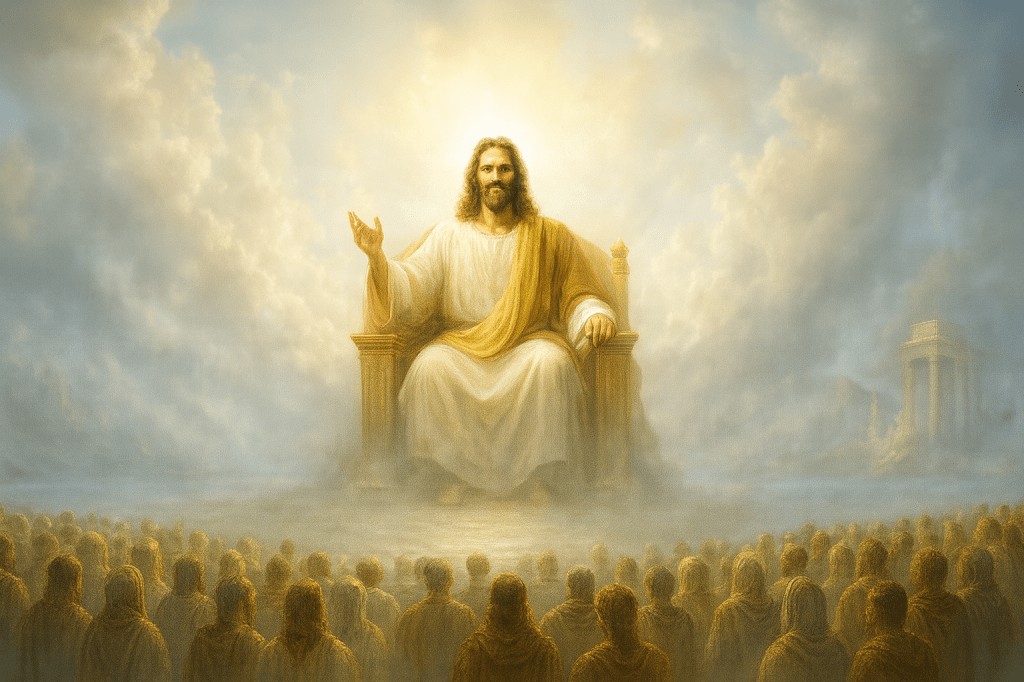
In the the Song of Solomon 5:9 the young woman who longs to be with her Love says to the Young Women of Jerusalem, “Make this promise to me, O Women of Jerusalem – If you find my lover, tell Him I am weak with love” (Song of Solomon 5:8 NLT)To which they respond, “Why is your lover better than all the others? O woman of rare beauty? What makes your lover so special that we must promise this?” (Song of Solomon 5:9 NLT). This is got me thinking. What makes our King better than the others? Are there examples in the bible that show how Yahweh is the One true God? well, of course there are! Lets dive in and see what the bible teaches us about the One True God vs. all other gods.
- Yahweh vs. Baal
- The Ten Plagues vs. Egypt’s Gods
- The Ark of the Covenant vs. Dagon
- Daniel’s God vs. Babylon’s gods (Daniel 3 & 6)
- Paul in Athens vs. the “Unknown God” (Acts 17:16–34)
- Why This Matters Today
Yahweh vs. Baal
The Showdown at Mount Carmel
1 Kings 18:16–40
Yahweh vs. Baal
Baal was one of the most prominent false gods worshiped by Israel’s neighbors, the Canaanites. He was considered the god of storms and fertility—the one people believed controlled the rain, harvests, and the cycle of life. His worship, however, was anything but life-giving. Ancient practices included ritual prostitution at shrines and even the horror of child sacrifice, where sons and daughters were burned alive as offerings (Jeremiah 19:5). To turn away from Yahweh and bow to Baal meant not only rejecting the Living God but embracing corruption, immorality, and death.
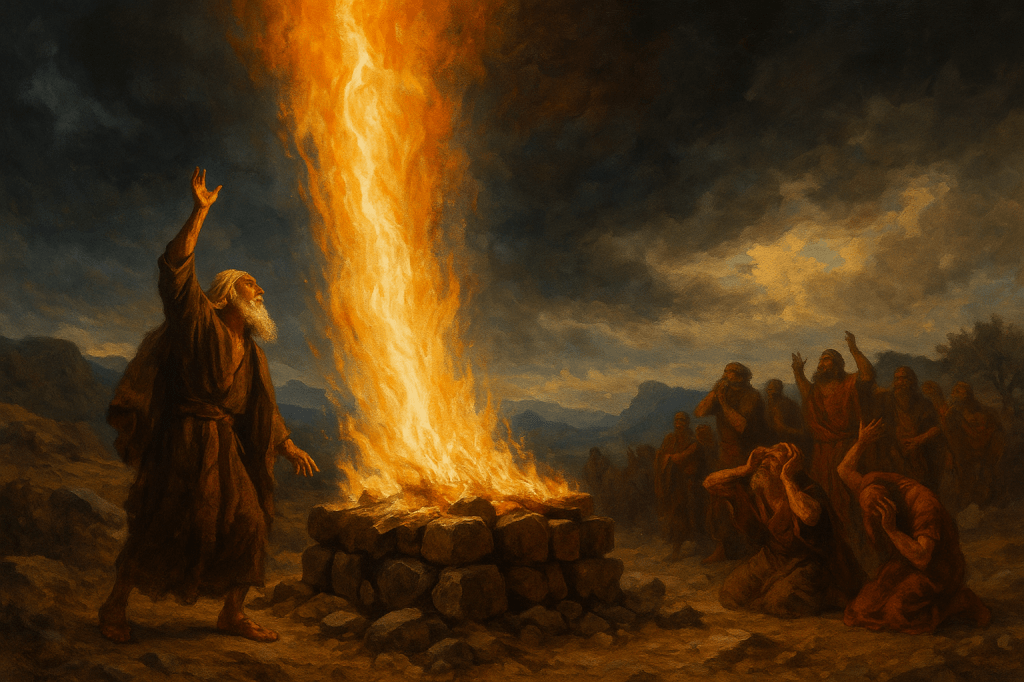
It was in this context that God raised up His prophet Elijah. In 1 Kings 18, the nation of Israel had been wavering—sometimes calling on Yahweh, other times running after Baal. Elijah called the people to Mount Carmel for a dramatic test. The challenge was simple: “How long will you waver between two opinions? If the LORD is God, follow Him; but if Baal is God, follow him” (1 Kings 18:21). To settle the matter, 450 prophets of Baal and Elijah would each prepare a sacrifice. They would cry out to their god, and whichever one answered by fire would be proven as the true God.
From morning until afternoon, Baal’s prophets shouted, danced, and performed rituals. When no answer came, they grew more desperate and began cutting themselves with swords and spears—shedding their own blood to appease their god, as was common in Canaanite worship (1 Kings 18:28). The scene was tragic: hundreds of voices crying to the sky, blood flowing, bodies exhausted—yet Baal remained utterly silent. The text says plainly, “But there was no response, no one answered, no one paid attention” (v. 29).
When it was Elijah’s turn, he repaired the altar of the Lord with twelve stones to symbolize the twelve tribes of Israel, reminding the people of their covenant with Yahweh. He then did something shocking: he drenched the altar, wood, and sacrifice with water until it overflowed into a trench (1 Kings 18:30–35). Humanly speaking, he made it impossible for fire to burn—because this test wasn’t about human effort but divine power.
Then Elijah prayed a simple, heartfelt prayer: “Answer me, Lord, answer me, so these people will know that you, Lord, are God, and that you are turning their hearts back again” (1 Kings 18:37). He didn’t shout or cut himself. He didn’t beg or bleed. He simply prayed, trusting the Living God to reveal Himself.
In an instant, the fire of the LORD fell from heaven. It consumed not only the sacrifice but also the wood, stones, soil, and even the water in the trench (v. 38). The people fell prostrate and cried out, “The LORD—He is God! The LORD—He is God!” (v. 39). In that moment, there was no doubt left—Yahweh had shown Himself as the one true God, supreme over Baal and every other pretender.
This showdown revealed a powerful truth: Baal was cruel, demanding blood and despair, but powerless to act. Yahweh, on the other hand, is living, responsive, merciful, and all-powerful. He doesn’t demand that His people wound themselves to get His attention. He hears the prayers of His people and responds with power that turns hearts back to Him.
Who Answers Us Today?
We may not bow to Baal today, but modern idols still compete for our hearts—money, success, relationships, status, entertainment, or even our own comfort. These false gods demand much but give nothing back. They leave us empty, wounded, and disillusioned—just like Baal’s prophets who shouted and bled but heard nothing in return.
Elijah’s story shows us that the true test of a god is whether they can answer. Our idols remain silent, but the Living God still answers. He responds to sincere prayer, to the cry of the repentant heart, and to those who seek Him with all their heart (Jeremiah 29:13).
The fire on Mount Carmel wasn’t just about consuming a sacrifice—it was about consuming doubt. God’s answer turned the hearts of the people back to Him. In the same way, when we bring our brokenness and our needs before Him, He answers with the fire of His presence, burning away deception and restoring our faith.
So we must ask ourselves: “Who am I calling on to answer me? Who am I trusting to provide, to satisfy, to rescue?” The silent gods of this world will always fail. But the God of Elijah—the God and Father of our Lord Jesus Christ—still answers by fire, still turns hearts back, and still proves Himself the One True God.
10 Plagues vs. Egypt’s Gods
Ten Signs. One Sovereign God.
Exodus 7-12
The Ten Plagues vs. Egypt’s Gods
The Contest Announced.
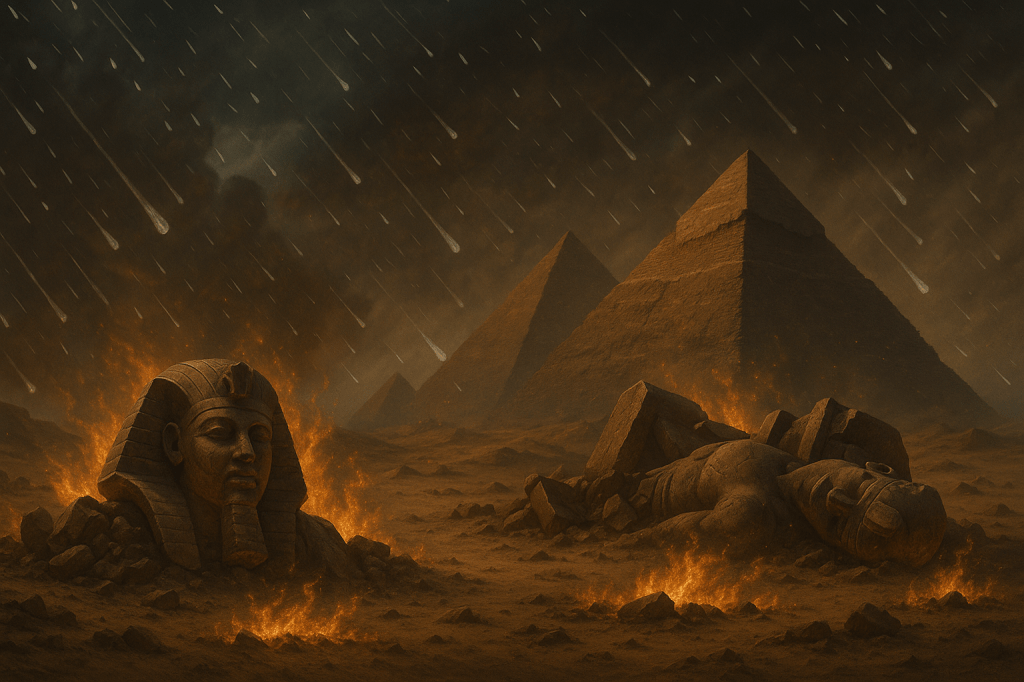
When Moses and Aaron stood before Pharaoh, the LORD made His purpose unmistakable: the coming judgments were not random disasters but public verdicts “against all the gods of Egypt” (Exod. 12:12; cf. 7:5; 9:14–16). Egypt’s pantheon claimed authority over river, soil, sky, life, healing, and kingship. The LORD, however, would expose their silence and impotence by commanding every realm they pretended to rule. Even Egypt’s magicians, at first able to mimic a sign or two, would soon confess, “This is the finger of God” (Exod. 8:19). Throughout, God often distinguished between Egypt and His people in Goshen, revealing both precision and mercy (Exod. 8:22–23; 9:4–7, 26; 10:23).
1) Water to Blood — Hapi Humiliated (Exodus 7:14–25)
Egypt revered Hapi, personification of the Nile’s life-giving flood. In a direct strike at the nation’s “lifeline,” the LORD turned all Egypt’s waters—river, canals, ponds, even water stored in vessels—into blood. Fish died, the river stank, and the land reeled (Exod. 7:19–21). This was no sleight of hand or localized blight; it was total systems collapse under Yahweh’s command. The god who “bore” the waters could not even keep them potable. Seven days later, the lesson still lingered (v. 25).
2) Frogs Swarm the Land — Heqet Shamed (Exodus 8:1–15)
Heqet, the frog-headed goddess of fertility and renewal, symbolized abundance and life. The LORD multiplied that symbol until it became misery: frogs in beds, ovens, kneading bowls—everywhere. Pharaoh pleaded with Moses to entreat the LORD to remove them (Exod. 8:8–13). Here the contrast is stark: idolaters could not make sacred symbols serve them, but Yahweh could send and remove them at His word. Only the living God controls the blessing and its boundaries.
3) Dust Becomes Gnats (Lice) — Geb Overruled (Exodus 8:16–19)
Geb, the earth god, was associated with soil and stability. At God’s command, Aaron struck the dust of the earth and it became gnats (or lice) upon man and beast (Exod. 8:16–17). Egypt’s magicians tried and failed to replicate this sign and confessed what Pharaoh would not: “This is the finger of God” (v. 19). Even the dust obeyed Yahweh; Geb had nothing to say.
4) Swarms Devastate Egypt — Khepri Checked (Exodus 8:20–32)
Khepri, often depicted with a scarab or fly head, symbolized daily rebirth and the sun’s movement. The LORD sent ruinous swarms to fill Egyptian houses and ravage the land, yet Goshen was spared (Exod. 8:22–24). The plague showcased divine precision: the Creator can commission or restrain even the smallest swarms—and He can draw a bright line of protection around His people. Khepri, guardian of “renewal,” could neither stop nor heal the rot.
5) Livestock Struck — Hathor and Apis Brought Low (Exodus 9:1–7)
Egypt prized its cattle, not only economically but theologically, venerating Hathor (often cow-headed) and Apis (the sacred bull). The LORD sent a severe pestilence on Egypt’s livestock, while Israel’s herds remained untouched (Exod. 9:3–6). Pharaoh investigated and found it exactly so (v. 7). Yahweh demonstrated mastery over wealth, strength, and agricultural life—domains Egypt credited to its bovine deities.
6) Boils on Flesh — Healers Silenced (Exodus 9:8–12)
Egypt invoked Sekhmet (war/healing), Isis (magic/healing), and the deified physician Imhotep for protection and cures. At God’s command, soot thrown heavenward became fine dust that produced boils and sores on people and animals (Exod. 9:8–10). The magicians could not even stand before Moses because of the boils (v. 11). No charm, temple rite, or patron deity could reverse what the LORD sent. The supposed healers were powerless before the Holy One.
7) Hail and Fire — The Sky Serves Yahweh (Exodus 9:13–35)
The heavens, personified by Nut (sky), Shu (air), and Tefnut (moisture), were thought to regulate weather and order. The LORD unleashed unprecedented hail, with fire flashing in its midst, shattering Egypt’s fields, trees, and people who ignored the warning (Exod. 9:22–26). Those Egyptians who feared the word of the LORD sheltered their servants and livestock and were spared (v. 20). The sky is no goddess; it is God’s servant. He commands the storm—and mercy within the storm.
8) Locusts Finish the Ruin — Seth Subdued (Exodus 10:1–20)
Associated with chaos and violent storms, Seth could not restrain the LORD’s decree. An east wind brought locusts “such as had never been”, devouring everything left after the hail (Exod. 10:13–15). At Moses’ prayer, a west wind carried them away (v. 19). Yahweh orders not only the swarm but the winds that bear them. Chaos itself must yield to His word.
9) Darkness You Can Feel — Ra Extinguished (Exodus 10:21–29)
At the apex of the pantheon stood Ra, the sun god, symbol of royal power and cosmic order. The LORD covered Egypt with a thick darkness for three days; people did not see one another or move—“but all the people of Israel had light where they lived” (Exod. 10:21–23). Yahweh “switches off” Egypt’s greatest deity as easily as a lamp, and He preserves light for His own. Divine sovereignty could not be clearer.
10) The Death of the Firstborn — Pharaoh and His Pantheon Judged (Exodus 11–12)
Egypt regarded Pharaoh as a living god, guarantor of Ma’at (order) and son of Ra. At midnight, the LORD struck the firstborn in every Egyptian household, from Pharaoh’s heir to the lowest slave; a great cry rose in Egypt. Yet every Israelite home marked by the blood of the lamb was passed over (Exod. 12:12–13, 29–30). Here the verdict falls on Egypt’s throne and its gods alike: salvation is not by empire or magic but by the blood provided by God. The Exodus begins, and with it, Israel’s identity under the LORD’s covenant care.
Why Yahweh Is Greater
Across these judgments, the LORD demonstrates scope (river to dust, insects to livestock, sky to sun, throne to nursery—every realm obeys Him), precision (Goshen spared, storms timed, winds reversed), power (magicians silenced, deities mocked, king humbled), and purpose: “that you may know that I am the LORD” (Exod. 7:5; 9:14–16; 10:2; 12:12). The gods of Egypt are limited, silent, and powerless; Yahweh speaks, acts, judges, and saves.
Texts for Study
Read the narrative in Exodus 7–12 with these lenses: God’s stated purpose (7:5; 9:14–16; 12:12), the magicians’ breaking point (8:18–19), distinctions for Goshen (8:22–23; 9:4–7, 26; 10:23), and the Passover provision (12:1–13, 21–30). Each scene reveals another pretender toppled and the LORD alone exalted!
The Ark of the Covenant vs. Dagon
Nothing Stands Before His Presence
1 Samuel 5:1-5
The Ark of the Covenant vs. Dagon
The Philistines, long-time enemies of Israel, believed they had won the ultimate victory when they captured the Ark of the Covenant in battle (1 Samuel 4:10–11). The Ark was the sacred symbol of God’s presence with His people, and with 30,000 Israelite soldiers dead and the Ark in Philistine hands, it looked like Yahweh had been defeated. Israel mourned, believing the “glory had departed” (1 Samuel 4:21–22). The Philistines, however, rejoiced and carried the Ark in triumph to Ashdod, placing it in the temple of their god, Dagon.
Dagon was a Philistine deity, often portrayed with human and fish-like features, connected with fertility, grain, and provision. His worship involved idolatrous feasts and pagan immorality, common to the cults of the ancient Near East. By setting the Ark in Dagon’s temple, the Philistines were making a bold statement: Yahweh had been captured, defeated, and made to bow before Dagon.
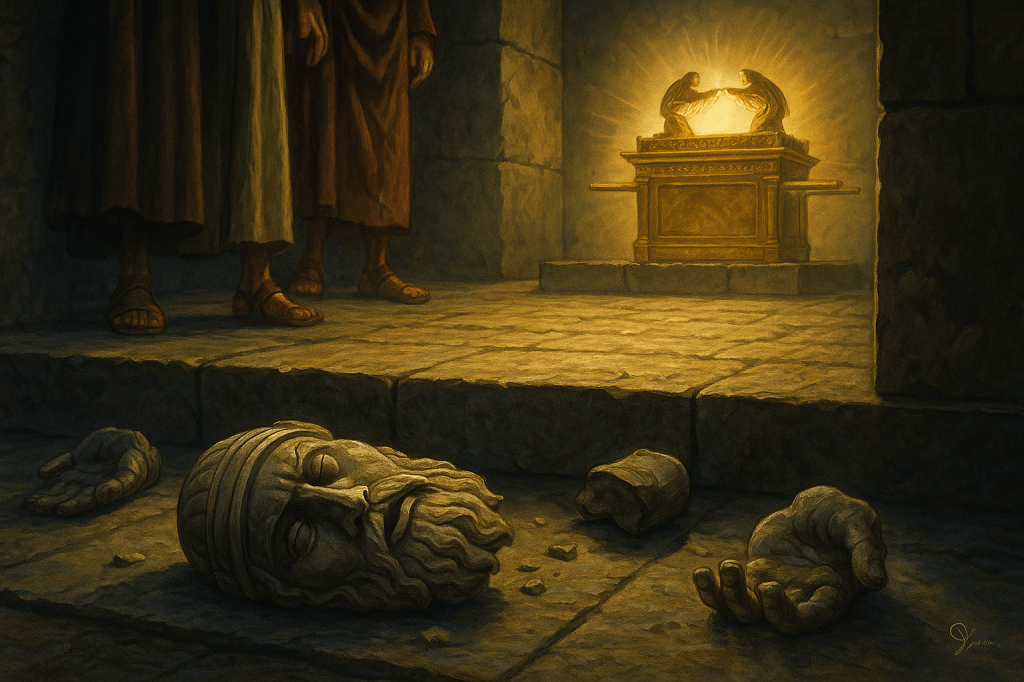
But God cannot be mocked. The next morning, when the people of Ashdod entered the temple, they found Dagon’s statue toppled, lying face down before the Ark of the LORD (1 Samuel 5:3). The irony is thick: the so-called god of the Philistines was bowing in the posture of worship before Yahweh’s presence. Instead of repenting, the Philistines simply “took Dagon and put him back in his place” (v. 3). The living had to rescue their dead god.
The following morning, the humiliation deepened. Dagon had fallen again before the Ark, but this time his head and hands were broken off, lying on the threshold, leaving only his torso intact (1 Samuel 5:4). The symbolism was unmistakable. In the ancient world, beheading and the removal of hands were signs of total defeat (cf. 1 Samuel 17:51; Judges 8:6). Yahweh had not only forced Dagon to bow but also decapitated and disarmed him, showing absolute supremacy. From that day forward, the priests of Dagon refused to step on the temple threshold where their god was shattered (v. 5), a lasting reminder of their shame.
This story reveals the power of Yahweh in contrast to the impotence of idols. Dagon was nothing more than a lifeless statue of stone and wood—he could not speak, move, or defend himself (Psalm 115:4–7). His worshipers had to lift him back into place, but Yahweh needs no one to uphold Him. Without an army, without a sword, without a single Israelite soldier, the presence of God alone toppled the false god of the Philistines. As Isaiah later declared, “I am the LORD, and there is no other; apart from me there is no God” (Isaiah 45:5).
The contrast could not be sharper: Dagon was powerless, broken, and exposed as a fraud. Yahweh was—and is—living, victorious, and untouchable. The Philistines thought they had captured Israel’s God, but instead, He marched into their temple as conqueror.
Daniel ‘s God vs. Babylon’s gods
Laws Condemn but Yahweh Delivers
Daniel 3 & 6
Daniel’s God vs. Babylon’s gods (Daniel 3 & 6)
The Empire = the Religion
Babylon’s religion was inseparable from its state power. The chief god Marduk (also called Bel, cf. Jeremiah 50:2, NLT) stood at the center of imperial theology; to honor Babylon’s gods was to honor Babylon’s king. Nebuchadnezzar embodied this merging when he raised a colossal golden image on the plain of Dura—likely ninety feet high—summoning “peoples, nations, and languages” to bow at the sound of his imperial music (Daniel 3:1–7, NLT). It was worship by decree: conform or burn.
Refusing to Bow (Daniel 3)
Among the gathered officials were three Jewish exiles—Shadrach, Meshach, and Abednego—three young Jewish men who had been exiled into Babylon and chosen, along with Daniel, to serve in the king’s court because of their intelligence and lack of blemish. They were given new Babylonian names in an effort to assimilate them into this new Babylonian culture and religion. They were proven to be special and were promoted in the kingdom (Daniel 2:49, NLT), but they never strayed from their God. They were trusted, high-ranking administrators in the Babylonian government trained to serve in the king’s royal court, but in their hearts they were true believers of Yahweh and fully dedicated to Him as their God.
But this day, they refused to bow by order of the king. They would bow out of respect before the king, but could not bow to acknowledge him and his religion as true. When hauled before Nebuchadnezzar, their answer was calm and unbending:
“If we are thrown into the blazing furnace, the God whom we serve is able to save us. He will rescue us from your power, Your Majesty. But even if he doesn’t, we want to make it clear to you, Your Majesty, that we will never serve your gods or worship the gold statue you have set up.” (Daniel 3:17–18, NLT)
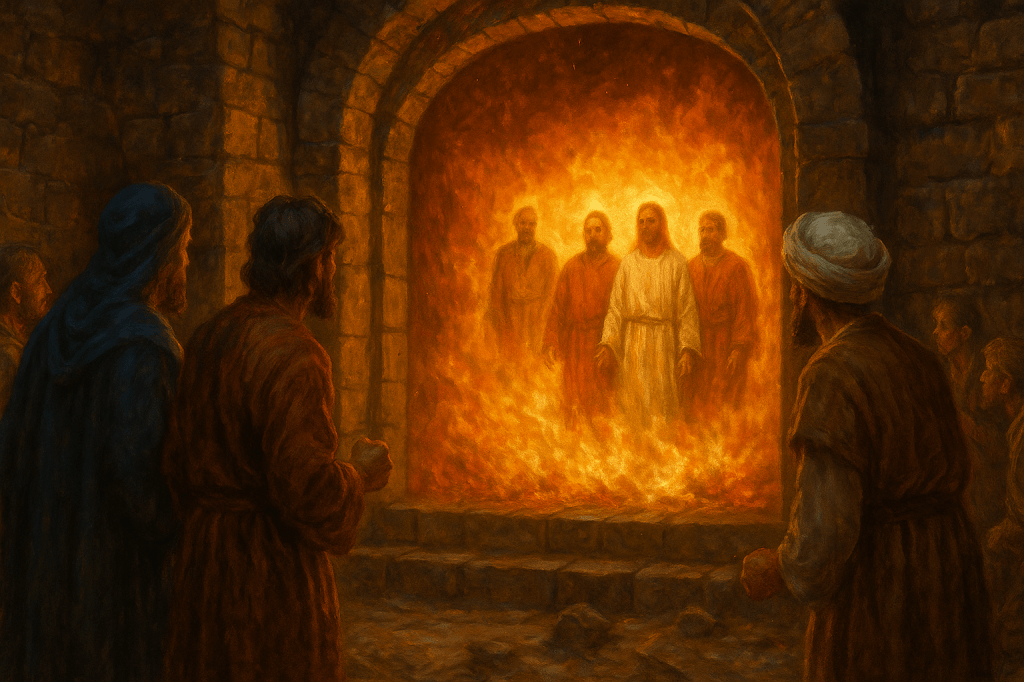
The king’s fury raged, matching the heat of the furnace—it was stoked seven times hotter! He demanded they be thrown into the fire for their insolence. The fire was so fierce that the men who threw them in died from the flames (Daniel 3:19–22, NLT). Yet inside this fiery blaze, the king saw something astonishing, a miracle by anyone’s standard—their three men alive and standing with a fourth man in the fire, “like a son of the gods,” walking with them, and the three emerged without even the smell of fire (Daniel 3:24–27, NLT). Nebuchadnezzar—who exalted himself and his religion, demanding worship—found himself confessing the supremacy of Israel’s God:
“There is no other god who can rescue like this!” (Daniel 3:29, NLT)
Everyone who witnessed this saw that nothing could stand against the One True God. Babylon’s gods promised protection through obedience to the state, relying on the strength of men to defend them, but Yahweh provided unparalleled, supernatural protection in defiance of idolatry—not to rebels, but to loyal servants whose first allegiance remained with their True and Living God.
A Law Against Prayer (Daniel 6)
Decades later, under a new ruler, Darius of the Medo-Persian administration, Daniel’s exemplary service stirred jealousy among the elite. His rivals could find no corruption in him, so they targeted his heart. They knew he loved his God entirely and was faithful to Him alone, so they manipulated the king into signing an irrevocable decree: for thirty days no one could petition any god or man except the king (Daniel 6:6–9, NLT). It was Babylon’s old strategy in Persian clothing—your devotion to the king determines your holiness.
Daniel’s response was simple; he held steadfast to his God. He went home, opened his windows toward Jerusalem, and prayed as he had always done—three times a day (Daniel 6:10, NLT). They knew this would happen, so they spied on him to catch him in the act. He was arrested and condemned, thrown into a lions’ den, and the stone sealed with the king’s signet sealed the entrance (Daniel 6:16–17, NLT). Darius was grieved because he loved Daniel. He realized he had been deceived, but a king’s decree is irrevocable, so he worried sleeplessly all night. At dawn he hurried to Daniel:
“Daniel, servant of the living God! Was your God, whom you serve so faithfully, able to rescue you from the lions?” (Daniel 6:20, NLT)
From the darkness came Daniel’s voice. God had sent His angel and shut the lions’ mouths! To the great relief of the king, Daniel was unharmed because he was found blameless before God—and he had committed no crime against the king (Daniel 6:22, NLT). The accusers met the fate they designed, and just as Nebuchadnezzar had before him, Darius acknowledged the One True God, issuing a decree revering Israel’s God:
“He is the living God and he will endure forever. His kingdom will never be destroyed, and his rule will never end. He rescues and saves his people; he performs miraculous signs and wonders in the heavens and on earth.” (Daniel 6:26–27, NLT)
Why Yahweh Is Greater
Babylon’s gods, and kings, demanded forced worship. Their power was theatrical: trumpets, decrees, statues, seals. Yet they could not enter fire or close a lion’s mouth. Only the Lord—“the living God” (Daniel 6:26, NLT)—walks with His people in the flames and rules the beasts of creation. He saves those who will not bend the knee to idols, even when their positions, reputations, or lives are at risk (cf. Hebrews 11:33–34, NLT).
The witness of Daniel 3 and 6 is not merely that God can deliver, but that He alone is worthy of trust when obedience is costly. The empire’s gods preserve power; Israel’s God preserves people. Nebuchadnezzar’s own confession becomes the banner over both stories: “There is no other god who can rescue like this!” (Daniel 3:29, NLT).
Paul’s God vs. the “Unknown God”
Unknown to Known
Acts 17:16-34
Paul in Athens vs. the “Unknown God” (Acts 17:16–34)
A City Full of Altars
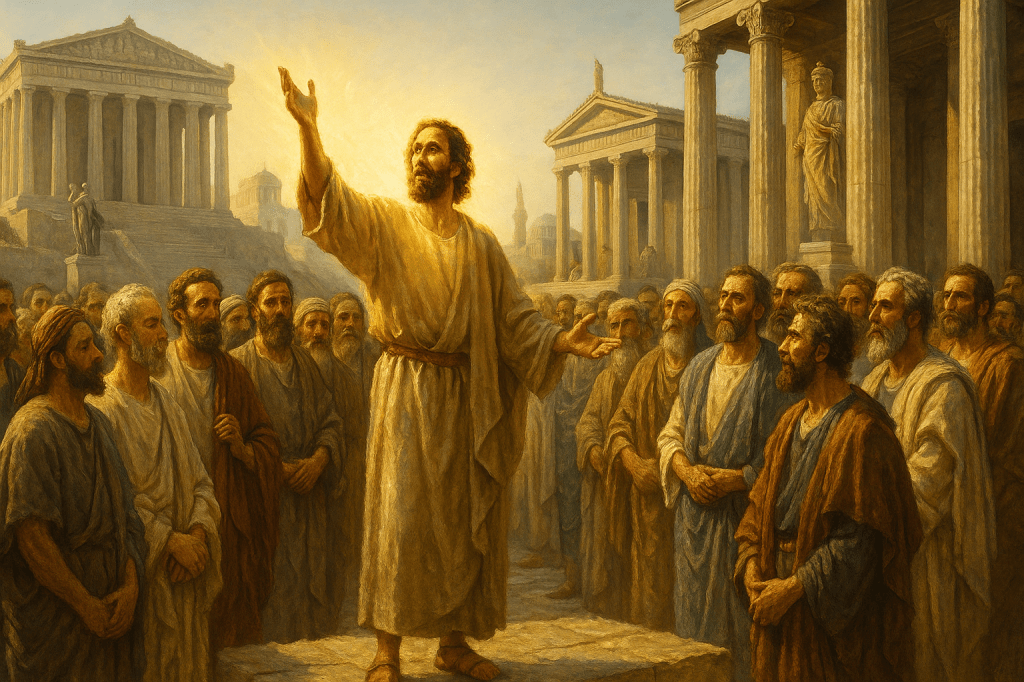
When Paul arrived in Athens, he was “deeply troubled by all the idols he saw everywhere in the city” (Acts 17:16, NLT). Temples and shrines to Zeus, Athena, Apollo and countless others crowded the skyline. The Athenians prided themselves on covering every spiritual base; they even kept an altar “To an Unknown God”—just in case they had missed one (Acts 17:23, NLT). Their worship, like much of Greco-Roman religion, could be tangled with drunken feasts and sexual immorality (cf. Romans 1:23–25, NLT). Into that marketplace of gods, Paul began reasoning in the synagogue and the public square until philosophers brought him to the Areopagus, the city’s council, to explain this “new teaching” (Acts 17:17–20, NLT).
The God They Didn’t Know—Now Announced
Standing among the council, Paul began with what they knew: “Men of Athens, I noticed that you are very religious in every way… I found an altar on which was written: ‘To an Unknown God.’ This God, whom you worship without knowing, is the one I’m telling you about” (Acts 17:22–23, NLT). Then he unveiled the One True God:
- Creator, not created. “He is the God who made the world and everything in it. Since he is Lord of heaven and earth, he doesn’t live in man-made temples” (Acts 17:24, NLT).
- Giver, not needy. “Human hands can’t serve his needs—for he has no needs. He himself gives life and breath to everything, and he satisfies every need” (Acts 17:25, NLT).
- Sovereign over history. “From one man he created all the nations… he decided beforehand when they should rise and fall, and he determined their boundaries” (Acts 17:26, NLT).
- Near and knowable. “His purpose was for the nations to seek after God… though he is not far from any one of us. For in him we live and move and exist” (Acts 17:27–28, NLT).
If God is the living Creator, Paul argued, then He is not like gold or silver or stone “designed by skilled craftsman and idols” (Acts 17:29, NLT). Idols are projections of us; the living God is Lord over us.
A Universal Call—Repent and Believe
“God overlooked people’s ignorance about these things in earlier times, but now he commands everyone everywhere to repent of their sins and turn to him. For he has set a day for judging the world with justice by the man he has appointed, and he proved to everyone who this is by raising him from the dead” (Acts 17:30–31, NLT). The response was mixed: some laughed at the resurrection, others wanted to hear more, and a few believed—among them Dionysius the Areopagite and Damaris (Acts 17:32–34, NLT). Even in the capital of ideas, the gospel cut a path.
Why Yahweh Is Greater
The Greek pantheon was crowded with gods who looked like us at our worst—jealous, immoral, petty, demanding worship yet unable to give life. The God Paul preached is holy, righteous, Creator and Sustainer, sovereign over history and near to the seeking heart. He is not a statue to be carried; He is the One in whom we “live and move and exist” (Acts 17:28, NLT). And He has acted decisively in history by raising Jesus from the dead, proving that salvation and judgment belong to Him (Acts 17:31, NLT).
Why This Matters Today
Our world has its own “altars to an unknown god”—vague spirituality, success, romance, influence—anything we hope will give meaning without surrender. Paul’s message still stands: the unknown can become known. God is not far; He gives you breath this very moment (Acts 17:25, 27, NLT). The call is simple and urgent—turn to Him, and trust the One He raised from the dead. In a city of many voices, Paul said what we still need most to hear: there is one living God, and He has made Himself known in Jesus.
To view the condensed version “Why Jesus is Better” in 5 Minutes with God click here.
If Gems of Knowledge has blessed your walk with Christ, please subscribe or consider partnering with us today. Your gift helps keep these devotionals free for everyone and carries God’s Word to more hearts. Every seed matters—thank you for sowing into this work! 💛
Test everything by the Word and the Spirit (John 16:13)


Leave a comment