Introduction
The book of Revelation was never meant to terrify God’s people or turn believers into fearful spectators of the future. It was written to reveal—to uncover what is already at work in the world and to call God’s people to faithfulness, discernment, and allegiance to the Lamb.
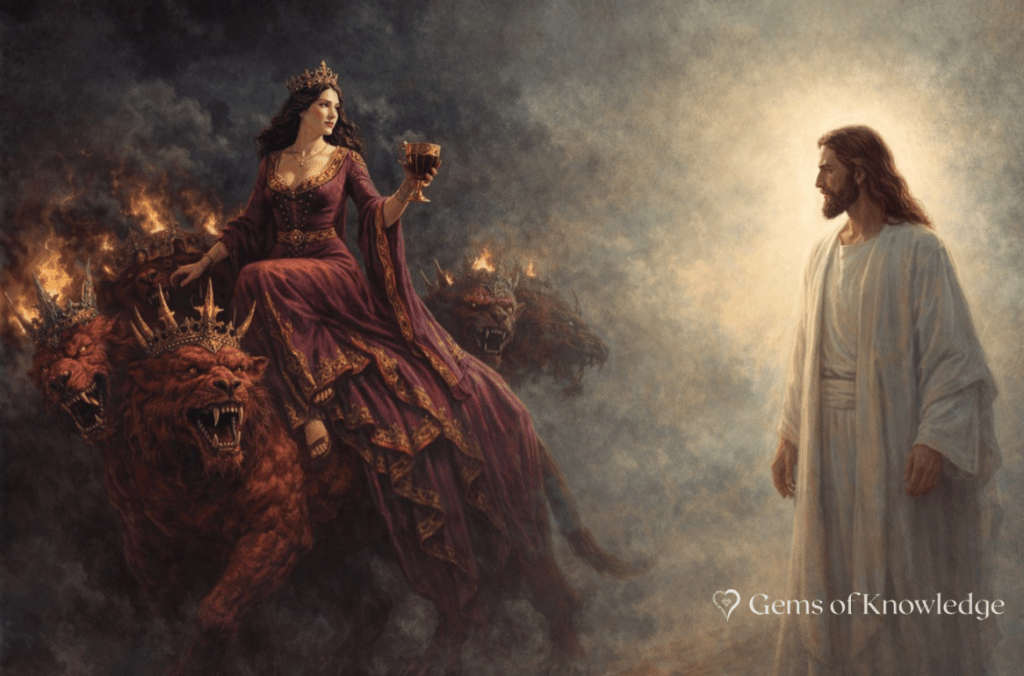
In Revelation 17, John is shown a striking vision: a woman riding a beast. This image is intentional and layered with meaning. It reveals how evil operates—not only through force and power, but through influence, persuasion, and counterfeit spirituality. What John sees is not merely a future event, but a recurring pattern that has appeared throughout history and is still at work today.
This teaching is not about identifying people.
It is about recognizing systems, spirits, and allegiances—and understanding how God calls His people to live faithfully without fear.
Teaching Outline (with Jump Links):
- Apocalyptic Language: How Revelation Communicates Truth
- The Beast: Power Without God
- The Woman: Babylon the Great
- Seduction vs. Persecution
- The Self-Destruction of Evil
- Babylon vs. the Bride
- Allegiance: The Real Issue
- Living Faithfully Without Fear
Apocalyptic Language: How Revelation Communicates Truth
Revelation is written in apocalyptic language—rich with symbols, imagery, and layered meaning. This style is not meant to obscure truth, but to reveal it to those who are spiritually attentive.
The word revelation literally means “unveiling.” John is not invited to speculate about dates or decode headlines; he is invited to see how the spiritual realm operates behind visible systems in the world.
Fear-based interpretations miss the point. Revelation does not magnify evil—it exposes it. The book consistently centers on the sovereignty of God, the victory of the Lamb, and the faithfulness of those who follow Him.
The Beast: Power Without God
The beast John sees is scarlet, covered with blasphemous names, and marked by seven heads and ten horns (Revelation 17:3).
In Scripture, scarlet is often associated with wealth, luxury, bloodshed, and sin (Isaiah 1:18; Nahum 2:3). This beast represents a worldly power system elevating themselves above God—political, economic, military, or cultural authority that demands loyalty apart from Him.
The seven heads are explained in the text itself:
- Seven mountains (Rev. 17:9), historically associated with Rome
- Seven kings (Rev. 17:10), symbolizing complete authority
Seven in Scripture represents fullness. This is not one man—it is a fully developed, God-opposing system.
The ten horns represent authority that is strong but temporary:
- Ten kings who receive power “for a short time” (Rev. 17:12)
The blasphemous names are key. In Scripture, blasphemy is not only insulting God—it is claiming divine authority that belongs to Him alone. When systems redefine truth, morality, or salvation, they are engaging in blasphemy.
The Woman: Babylon the Great
John does not see the beast alone. He sees a woman riding it.
She is not the beast.
She uses the beast.
Revelation names her plainly:
“Babylon the Great, the mother of prostitutes and of the abominations of the earth.” (Rev. 17:5)
Babylon in Scripture is never merely a city. It is a spiritual and cultural system that stretches from Genesis to Revelation—one that mixes truth with compromise and offers blessing without obedience.
She is described as:
- Adorned in purple and scarlet (wealth, royalty)
- Covered in gold and jewels (religious beauty)
- Holding a golden cup (appears sacred)
But the cup is full of abominations.
This is counterfeit righteousness—spiritual language without submission to God.
Seduction vs. Persecution
The most dangerous threat to God’s people is not always persecution—it is deception.
Force creates martyrs.
Seduction creates converts.
Babylon looks beautiful. She feels confident. She speaks with authority. She often claims Christ—but quietly adds requirements He never gave. Sound familiar?
This is why Scripture warns us:
“If righteousness could be gained through the law, Christ died for nothing.” (Galatians 2:21)
Jesus is acknowledged—but not trusted as enough.
This is why this deception is so dangerous. It often appears inside churches that profess Christ, yet quietly teach that Jesus is not enough. Man-made doctrines are piled onto believers as requirements for salvation, shifting trust from Christ’s finished work to human performance. When anything is added to the cross, Christ is no longer trusted as sufficient.
We see this in churches even today – churches that claim the name of Christ, yet quietly pile the doctrines of man upon the people. According to these systems, Jesus is not enough on His own. His atonement is acknowledged—but subtly treated as insufficient. They teach for you to be accepted by God you must follow their additional rules, rituals, behaviors, or allegiances defined by men. Jesus Himself confronted this very distortion. Quoting the prophet Isaiah in Matthew 15:7-9 when He said, “You hypocrites! Isaiah was right when he prophesied about you, for he wrote, ‘These people honor Me with their lips, but their hearts are far from Me. Their worship is a farce, for they teach man-made ideas as commands from God.” (also see Isaiah 29:13; Mark 7:6–7; Ezekiel 33:31)
This is the seduction of the woman riding the beast – we must be very cautious about where we worship, what is being taught, and whose voices we allow to shape our faith. Not every place that uses the name of Jesus is leading people to Him. Not every teaching that sounds biblical is rooted in truth. Scripture repeatedly warns us that deception often comes clothed in religious language and sincere conviction (Matthew 7:15, 2 Corinthians 11:13-15, Romans 10:2, Colossians 2:8, Hosea 4:6, Galatians 1:6-9) .
This is why we must know the Word for ourselves, not secondhand or filtered through the opinions of men. When we do not study Scripture personally, when we do not remain anchored in Christ alone, we become vulnerable to subtle distortion. But when we stay rooted in God’s Word, led by the Holy Spirit, we will recognize truth, resist deception, and remain faithful to the Lamb who never misleads His people. This is why Scripture calls us to test every teaching, examine every spirit, and remain anchored in Christ alone (1 John 4:1; Acts 17:11). The Lamb does not deceive, and those who know His voice will not follow another (John 10:4–5).
The Self-Destruction of Evil
One of the most sobering truths in Revelation is this:
The beast turns on the woman.
The very power she rides eventually destroys her (Rev. 17:16).
Evil systems always collapse inward. They have no loyalty—only appetite. God does not endorse evil; He allows it to expose itself.
False religion cannot save.
Compromise cannot endure.
Only truth stands.
Scripture consistently shows that evil collapses under its own weight. The beast turns on the woman (Rev. 17:16), alliances betray themselves (Obadiah 1:7), and violence recoils back on its source (Psalm 37:15). God does not endorse evil—He allows it to expose itself (Romans 1:24). False religion cannot save (Jer. 2:13). Compromise cannot endure (James 1:15). Only what is built on truth stands (Matthew 7:24–27).
(Also see Proverbs 26:27, Romans 1:26, 28, Habakkuk 2:16, Isaiah 47:11)
Babylon vs. the Bride
Revelation presents two women:
| Babylon | Bride of Christ |
|---|---|
| Adorned outwardly | Adorned by God |
| Rides the beast | Walks with the Lamb |
| Seeks power | Submits in faith |
| Temporary | Eternal |
One manipulates influence.
The other waits in faithfulness.
Allegiance: The Real Issue
The mark of the beast is not separate from the beast’s system—it flows from it.
The beast is the structure.
The system is how it governs.
The mark is personal allegiance.
The mark is placed on the forehead (mind, belief, worldview) and the hand (action, participation).
It represents thinking like the beast and acting on its behalf.
No one accidentally receives the mark. It is tied to choice, worship, and consent.
God’s people are described this way:
“They follow the Lamb wherever He goes.” (Rev. 14:4)
Living Faithfully Without Fear
Revelation does not call believers to panic or isolation—it calls them to discernment.
This is not about identifying villains.
It is about examining truth and allegiance.
Who are you trusting to carry you?
Who are you riding with?
The Bride does not ride the beast.
She waits for the Lamb.
And the Lamb always wins.
Key Teaching Truth
Revelation is not meant to create fear of the future,
but faithfulness in the present.
Jesus tells us, “I am leaving you with a gift—peace of mind and heart. And the peace I give is a gift the world cannot give. So don’t be troubled or afraid.” (John 14:27). 💎
To read more Mining the Word in-depth Bible Studies click here.
If Gems of Knowledge has blessed your walk with Christ, please subscribe or consider partnering with us today. Your gift helps keep these devotionals free for everyone and carries God’s Word to more hearts. Every seed matters—thank you for sowing into this work! 💛
Test everything by the Word and the Spirit (John 16:13)
 Gems of Knowledge
Leave a comment