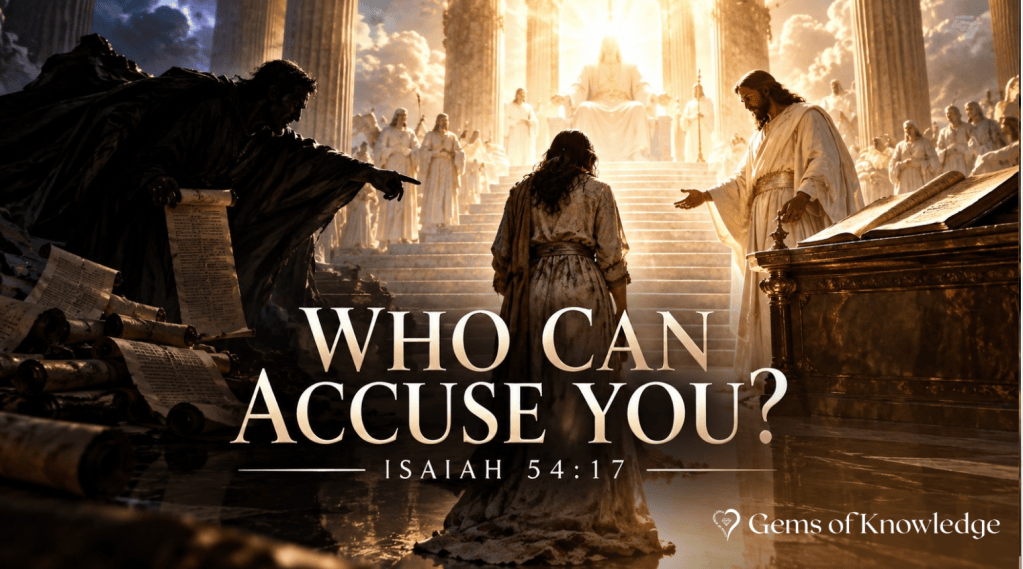
⛏️ Mining the Word Bible Teaching | Isaiah 54:17
Key Scriptures: Isaiah 54:17; Zechariah 3:1–5; Romans 8:31–34; Colossians 2:13–15; 1 Timothy 2:5; 1 John 2:1–2; Revelation 12:10–11
No Weapon Formed Against You Shall Prosper
There are some verses we know so well that we can quote them without ever stopping to consider everything they are actually saying. Isaiah 54:17 is one of them.
“No weapon formed against you shall prosper,
And every tongue which rises against you in judgment
You shall condemn.
This is the heritage of the servants of the LORD,
And their righteousness is from Me,”
Says the LORD.
— Isaiah 54:17 NKJV
We know that first line: “No weapon formed against you shall prosper!” We quote it when we’re under attack. We pray it when we’re facing opposition. We remind ourselves of it when it feels like the enemy is coming from every direction. And rightly so.
But have you ever stopped long enough to notice what comes next? “And every tongue which rises against you in judgment you shall condemn.”
Now we aren’t simply looking at a battlefield. We’re hearing the language of accusation and judgment. There is a weapon being formed, a tongue rising in accusation, and judgment being sought. Then God declares something incredibly important: “Their righteousness is from Me.”
That changes the way I read this verse.
First, Let’s Put Isaiah 54:17 in Context
Before we apply this verse to ourselves, we need to understand who God was originally speaking to. Isaiah 54 is addressed to Zion—Jerusalem, God’s covenant people.
The chapter begins with the barren, desolate woman being told to sing because God is going to restore her. She is told to enlarge her tent because what appears empty will become fruitful. God describes Himself as her Husband and Redeemer and promises that His faithful love and covenant of peace will not be shaken.
Then the chapter ends with Isaiah 54:17.
So “no weapon formed against you shall prosper” wasn’t originally written as a general promise that nothing bad could ever happen to anyone who quoted the verse. It was spoken in the context of God’s covenant faithfulness, restoration, protection, and vindication of His people.
And when we follow the themes of accusation, righteousness, and vindication through the rest of Scripture, they ultimately lead us straight to Jesus.
Meet the Accuser
The Hebrew word שָׂטָן (satan) means adversary or accuser. Depending on the context, the word can refer generally to an adversary, but Scripture also uses Satan for the spiritual adversary of God and His people. Accusation is one of the activities Scripture specifically associates with him.
Revelation calls Satan:
“the one who accuses them before our God day and night.”
— Revelation 12:10 NLT
Think about what an accuser does. He points toward guilt. He reminds you of what you did, where you failed, who you used to be, and every reason you should be ashamed to stand before God.
And here is where this teaching gets uncomfortable before it gets wonderful: sometimes the accusation contains truth.
We have sinned. We have failed. We have made terrible choices. We cannot stand before God and defend ourselves by saying, “But I’ve never done anything wrong.”
Thankfully, that isn’t our defense.
Joshua Stood There in Filthy Clothes
Zechariah 3 gives us an extraordinary picture of this. Zechariah sees Joshua the high priest standing before the angel of the LORD, and Satan is standing beside him.
“The Accuser, Satan, was there at the angel’s right hand, making accusations against Jeshua.”
— Zechariah 3:1 NLT
Joshua has a problem: his clothes are filthy. He doesn’t stand before God looking spotless while declaring that Satan has completely fabricated the evidence. His condition is visible.
But then something remarkable happens. The LORD rebukes Satan and orders Joshua’s filthy garments to be removed.
“See, I have taken away your sins, and now I am giving you these fine new clothes.”
— Zechariah 3:4 NLT
Don’t miss what happened. Joshua didn’t clean his own clothes. God removed them. Joshua’s answer to the accusation wasn’t his own righteousness; it was God’s mercy.
And hundreds of years later, Jesus would accomplish something far greater.
The Accuser Meets the Mediator
The New Testament gives Jesus an extraordinary title: Mediator.
The Greek word is μεσίτης (mesitēs), meaning a mediator or one who stands between parties. Scripture says:
“For there is only one God and one Mediator who can reconcile God and humanity—the man Christ Jesus.”
— 1 Timothy 2:5 NLT
There is an important language distinction here. Satan comes from the Hebrew word meaning adversary or accuser. Mediator is not a Hebrew name for Jesus; the New Testament word applied to Jesus is the Greek mesitēs. But the contrast is powerful: Satan is the Accuser; Jesus is the Mediator.
Scripture gives us another word for Jesus that fits this picture beautifully. John tells believers that when we sin, “we have an advocate who pleads our case before the Father. He is Jesus Christ, the one who is truly righteous” (1 John 2:1 NLT).
Jesus doesn’t mediate our case by pretending we never sinned. He does something infinitely better.
He paid for the sin Himself.
The Charges Against You Were Nailed to the Cross
This is where Colossians 2 becomes breathtaking:
“You were dead because of your sins and because your sinful nature was not yet cut away. Then God made you alive with Christ, for he forgave all our sins. He canceled the record of the charges against us and took it away by nailing it to the cross.”
— Colossians 2:13–14 NLT
The charges existed. God didn’t pretend there wasn’t a record. He canceled it.
And how did He cancel it? By nailing it to the cross.
Jesus didn’t come merely to argue that we deserved another chance. He came to pay a debt we could never pay ourselves. The cross wasn’t God deciding that sin didn’t matter. The cross demonstrated how much sin mattered—and how far God was willing to go to redeem us from it.
Jesus bore our sin, took our condemnation, and paid our debt. Because of Him, the record that stood against us was canceled.
And look at what Paul says immediately afterward:
“In this way, he disarmed the spiritual rulers and authorities. He shamed them publicly by his victory over them on the cross.”
— Colossians 2:15 NLT
The cross didn’t merely provide forgiveness for the accused. Through the cross, Christ triumphed over the spiritual powers.
Who Can Bring a Charge Against You?
Now listen to Paul’s language in Romans 8:
“If God is for us, who can ever be against us?”
— Romans 8:31 NLT
Paul then begins asking questions that sound remarkably like the language of accusation and judgment:
“Who dares accuse us whom God has chosen for his own? No one—for God himself has given us right standing with himself. Who then will condemn us? No one—for Christ Jesus died for us and was raised to life for us…”
— Romans 8:33–34 NLT
Who can bring the charge? Who can condemn?
Notice that Paul’s answer isn’t, “Nobody, because I’m a good person.” It isn’t, “Nobody, because I’ve never sinned.” It isn’t even, “Nobody, because every accusation made against me is false.”
His answer is Jesus.
Christ died. Christ was raised. God justifies.
The enemy can remind you of what you did. He can point toward where you have been and every filthy garment you once wore. But for the person who has turned to Christ, he cannot undo what Jesus accomplished at the cross.
Your answer isn’t:
“I’m innocent.”
Your answer is:
“I’m forgiven.”
What About the Courts of Heaven?
There really is courtroom imagery in Scripture. Daniel saw a heavenly court in which “the court began its session, and the books were opened” (Daniel 7:10 NLT). In Job 1–2, Satan appears before the LORD and challenges Job’s faithfulness. Zechariah sees Joshua standing before God while Satan accuses him, and Revelation describes Satan as the accuser of God’s people.
So when people use the phrase “Courts of Heaven,” there is certainly a biblical basis for recognizing heavenly scenes involving judgment, accusation, books, verdicts, and vindication.
However, we need to be careful not to go beyond what Scripture actually teaches. The Bible gives us heavenly courtroom imagery, but it does not give Christians an elaborate legal procedure or special formula we must learn before Jesus’ work can become effective for us.
Our confidence is not that we have learned how to argue our case better than the Accuser.
Our confidence is Jesus.
We don’t overcome because we know the right heavenly legal terminology. We overcome because Christ died, rose again, and stands as our Mediator and Advocate. The blood of Jesus has already answered the accusation against those who belong to Him.
They Overcame the Accuser
Revelation brings these ideas together beautifully. Immediately after identifying Satan as the accuser, Scripture says:
“And they have defeated him by the blood of the Lamb and by their testimony.”
— Revelation 12:11 NLT
Notice what comes first: the blood of the Lamb.
Their victory isn’t rooted primarily in their ability, goodness, spiritual knowledge, or perfect behavior. It is rooted in what Jesus accomplished.
The Accuser speaks, but the blood of Jesus speaks louder than the accusation.
Conviction Is Not Condemnation
There is an important distinction we need to make here. Being free from the Accuser does not mean God never confronts our sin.
The Holy Spirit convicts us because God loves us enough not to leave us where we are. Conviction identifies sin and draws us toward repentance, forgiveness, restoration, and change. Condemnation does something very different. It tells us that our sin is our identity, that we will never change, and that God doesn’t want us anymore.
Conviction draws us toward God.
Condemnation drives us away from God.
When God exposes something in us, we should respond quickly. Confess it. Repent. Turn around. Receive His forgiveness and allow Him to change us.
But once we have genuinely repented and brought our sin to Jesus, we don’t need to continue carrying something He already carried to the cross.
Now Go Back to Isaiah 54
With all of that in mind, read Isaiah 54:17 again:
“No weapon formed against you shall prosper,
And every tongue which rises against you in judgment
You shall condemn.
This is the heritage of the servants of the LORD,
And their righteousness is from Me,”
Says the LORD.
— Isaiah 54:17 NKJV
Do you see it differently now?
The verse doesn’t say weapons will never be formed. It says the weapon formed against God’s people will not ultimately prosper.
Scripture certainly doesn’t teach that believers never experience suffering, persecution, loss, false accusations, or consequences. Jesus Himself told His followers they would experience trouble in this world.
But the weapon does not get to determine God’s final verdict.
The accusation does not get to determine God’s final verdict.
And your past does not get to determine God’s final verdict.
Then look at the final words:
“Their righteousness is from Me.”
There it is.
Our answer to accusation has never been our ability to prove how righteous we are.
Our righteousness comes from Him.
When the Accuser Says, “Look What You Did”
Maybe this is where Isaiah 54:17 becomes intensely personal.
Sometimes the weapon isn’t a physical attack. Sometimes it is an accusation that keeps replaying in your mind. Maybe it concerns something you did ten years ago, a season you’re ashamed of, words you wish you could take back, or choices you would give anything to undo.
The enemy says, “Look what you did.”
You don’t have to pretend it never happened. You don’t have to rewrite your history or justify your sin.
You can point toward the cross and say:
“Look what Jesus did.”
That is the difference between defending yourself and trusting your Defender.
The Accuser may point to your past.
But the Mediator points to the cross.
No Weapon Gets the Final Word
So what does “no weapon formed against you shall prosper” mean for us?
It doesn’t mean Christians never suffer. It doesn’t mean nobody can hurt us. It doesn’t mean every earthly circumstance will end the way we want. And it certainly doesn’t mean we can live however we want and attach Isaiah 54:17 to our choices as spiritual insurance.
It points us toward something much greater: God is the One who ultimately establishes and vindicates His people, and in Christ our standing before Him rests on what Jesus has done rather than what we could ever accomplish ourselves.
The weapon may form. The accusation may be spoken. The enemy may point toward the evidence. And sometimes you may have to admit, “Yes, I did that.”
But then you can look toward the cross.
“And Jesus paid for that.”
The Accuser doesn’t get the final word. Your past doesn’t get the final word. Shame doesn’t get the final word. Other people’s opinions don’t get the final word.
God does.
💎 Gem to Mine
You don’t defeat accusation by proving you’ve never been guilty. You answer it by standing in what Jesus has already done. The Accuser may point to your past, but the Mediator points to the cross.
When the enemy says, “Look what you did,” remember:
“Look what Jesus did.”
Questions to Mine Deeper
- Is there something from my past that I continue carrying even though I have genuinely repented and brought it to Jesus?
- When I sin, do I run toward God in repentance or away from Him in shame?
- Have I confused the Holy Spirit’s conviction with condemnation?
- Am I trying to defend myself with my own goodness instead of resting in what Jesus accomplished?
- What accusation in my life needs to be answered with the truth of the cross?
💎 Now Mine It for Yourself
Don’t stop with what we’ve uncovered here.
Take some time to read Isaiah 54 from beginning to end for yourself. Then turn to Zechariah 3:1–5 and read the picture of Joshua standing before God while Satan accuses him. After that, read Romans 8:31–39 and Colossians 2:13–15.
Read slowly. Ask the Holy Spirit to help you understand what God has revealed in His Word. Pay attention to repeated ideas—accusation, righteousness, forgiveness, judgment, mercy, and what Jesus accomplished at the cross.
Then follow those words wherever Scripture takes you.
Write down what you discover. Compare Scripture with Scripture. Test what you see against God’s Word, and allow what you discover to draw you closer to Jesus.
There are more gems here. Go mine them. 💎
Prayer
Father, thank You for Jesus. I know I cannot stand before You based upon my own righteousness. I have sinned, failed, and fallen short, but Jesus carried my sin to the cross and paid the debt I could never pay.
When the enemy reminds me of my past, remind me of the cross. When shame tells me I am still who I used to be, remind me who I am in Christ. When Your Holy Spirit convicts me, give me humility to repent quickly and completely. And when condemnation tries to drive me away from You, teach me to recognize the difference and run toward You instead.
Jesus, thank You for being the Mediator of the New Covenant and my Advocate. Thank You that my confidence isn’t found in my ability to defend myself but in what You have already accomplished. Help me live in the freedom You purchased without using grace as an excuse for sin.
The weapon does not get the final word. The accusation does not get the final word.
You do.
In Jesus’ name, amen.
“No weapon formed against you shall prosper,
And every tongue which rises against you in judgment
You shall condemn.
This is the heritage of the servants of the LORD,
And their righteousness is from Me,”
Says the LORD.
— Isaiah 54:17 NKJV
CONTINUE THE JOURNEY
Dig Deeper Into God’s Word
Every passage holds a treasure waiting to be discovered. Explore more Mining the Word Bible studies, uncover deeper biblical truths, and grow closer to Jesus—one Gem at a time.
Did This Bless You? ☕
Every devotional, teaching, and podcast episode is created with love and shared freely. If Gems of Knowledge has encouraged you or helped you grow closer to Jesus, would you consider buying me a cup of coffee?
Your gift, no matter the size, helps me continue sharing God’s Word and the gems He places on my heart. Thank you for being part of this journey! ❤️
Want to support Gems of Knowledge regularly? Become a Monthly Ministry Partner.


Leave a Reply